For modern organizations drowning in unprecedented data volumes and struggling with traditional storage systems that offer:
Inflexible Data Silos
Mission-critical information trapped in rigid environments lacking modern API access
Integration Bottlenecks
Difficulty connecting with cloud-native tools or triggering automated, data-driven workflows
Operational Inefficiency
Manual data handling that creates severe delays in analysis and decision-making
Security & Provenance Risks
Major challenges in ensuring absolute data integrity, safety, and provenance at scale
VFS (Velocity File System) is the distributed, ledger based, storage solution that turns data liabilities into operational assets.
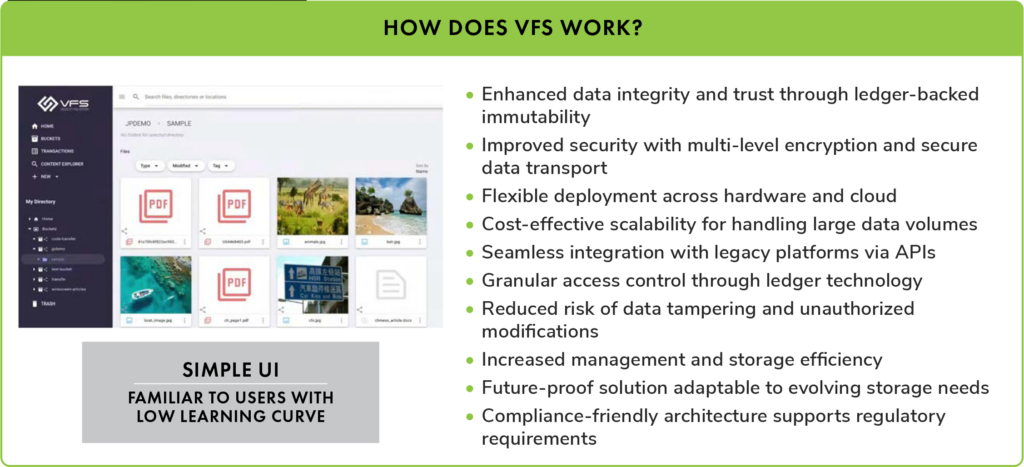
Velocity File System (VFS) is a robust, petabyte-scale distributed file system pairing a user-friendly web UI with a scalable backend. It features native AWS S3 API support for seamless integration. VFS automates pipelines, instantly triggering Python functions upon object ingestion. It includes strict access controls and object tagging for easy UI-based search. Security is ensured by an immutable ledger for data provenance, AES-256/TLS 1.3 encryption, and erasure coding to guarantee maximum durability with zero single points of failure.
Features and Benefits
Immutable Auditing: Uses distributed ledger architecture for an immutable history and tamper-proof audit trail. Ensures total data integrity, provenance, and metadata transparency.
End-to-End Encryption: Protects data at rest via mandatory AES-256 server-side encryption. Secure transit is guaranteed by TLS 1.3, establishing hardened connections across all volumes.
Scalability & Durability: Delivers petabyte-scale growth using replication and erasure coding. The architecture ensures high concurrency and eliminates single points of failure.
Native S3 Compatibility: Seamless API support for AWS S3, including S3 Select and Presigned URLs. Supports STS for temporary credentials, enabling instant cloud-native integration.
The Dark Wolf Difference
VFS uniquely bridges highly secure, on-premise storage with cloud-native flexibility. Unlike legacy systems requiring clunky add-ons, VFS features out-of-the-box S3 support and integrated event-driven computing. Unlike public clouds, which aren’t viable for air-gapped missions, VFS brings petabyte-scale architecture to your secure infrastructure, using a distributed ledger to guarantee tamper-proof data provenance.
Customer Successes
Our data solutions are accredited to the highest level within customer specific networks, to include the most sensitive compartments within the Intelligence Community. They are delivered at scale, including 1,200+ production datasets, 75 trillion records, 9 petabytes of data, 2.5 thousand users, 80+ thousand searches a week, and 30+ billion records ingested weekly.