For organizations and penetration testing teams using cloud services with:
Platform Volatility
Emerging enterprise-wide cloud platforms
Data Fragmentation
Multiple sources of truth for cloud configurations
Visibility Blindspots
Multi-vendor or hybrid cloud environments with unknown security postures
Audit Stagnation
Slow, manual methods for configuration review
Legacy Dependency
Manual security processes not originally developed for cloud systems
We offer SkyDrift to achieve rapid, automated configuration review and enhanced security visibility.
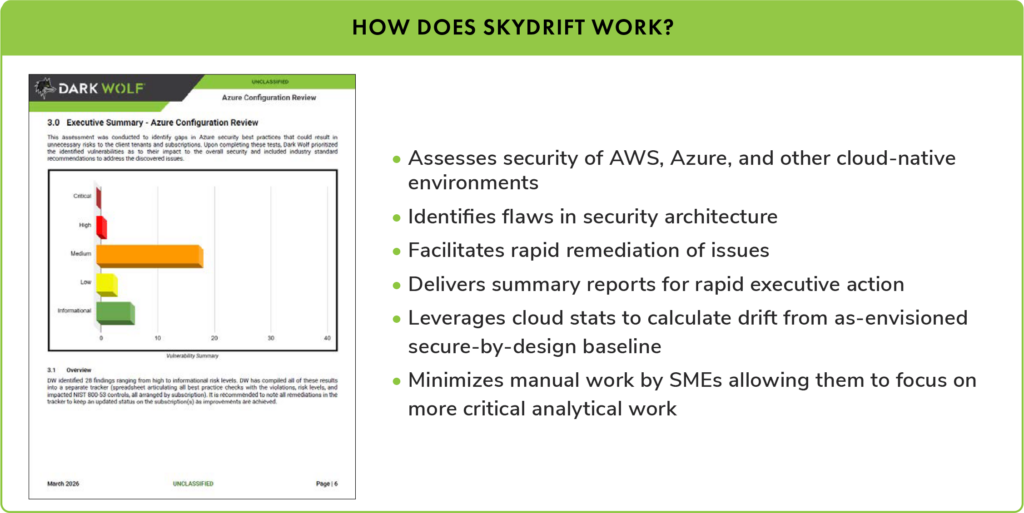
SkyDrift is an automated cloud tool that enables targeted security assessments of AWS, Azure, and other cloud-native environments. For organizations with emerging or large cloud presences, SkyDrift can rapidly identify flaws in cloud architecture, either for use by organizations to make immediate improvements, or to enable penetration testers by drastically cutting down time on initial auditing and reconnaissance.
Features and Benefits
Savings: Eliminates redundant infrastructure through sharing a single, centralized security system.
Speed: Provides faster security and audit approvals through automatic evidence gathering and report generation.
Visibility: Enables total system visibility through a centralized security service that provides separate, secure dashboards and strict access controls for every team.
Rapid Multi-Tenant Onboarding: Delivers a standard setup process that allows new teams to join quickly.
The Dark Wolf Difference
Backed by our expertise gained through competing at DEF CON and other world class hacking events, we perform audits and tests, and build reports for executive and technical audiences on the strengths and weaknesses of their security posture to facilitate security hardening. Unlike time-consuming manual audits, internal scripts, or standard security tools, SkyDrift provides a universal, ready-to-implement methodology that dramatically accelerates security coverage and efficiency.
Customer Successes
Dark Wolf deployed SkyDrift for the Air Force, conducting systematic, biannual security assessments across 20+ AWS accounts. These rigorous government-wide evaluations repeatedly exposed critical plain-text credentials, driving actionable security enhancements for the organizations. We used SkyDrift to gain full network and account-wide control starting from read-only access, allowing the customer to remediate critical vulnerabilities.
Dark Wolf’s Automated Cloud Configuration Auditing